02
SmartBra
There’s always something new to learn through user research, not only because each point of view is unique, but also because different questions can uncover new information. This was the case in a study involving users who experience pain caused by computer use. The project began with no defined product or service, as it was intended to be a needs discovery stage.
I was responsible for gathering user feedback through interviews and facilitating a co-design session with users and designers. This was essentially a qualitative investigation, and data collected through semi-structured interviews revealed key information about user behaviour. One user, in particular, shared that ergonomic furniture only partially helped, as it was not portable. This reflection led to a core insight: the problem is not the computer itself, but rather the lack of postural awareness when using it.
From this, a guiding “How Might We” question was developed:
How might we prevent pain while using computers by developing postural awareness?
The co-design session took place in person in Estonia with three potential users and three designers. I facilitated the session in English. Participants were informed about the project’s purpose, key pain points, and the problem statement. They then took part in a hands-on activity to generate ideas using paper and markers.
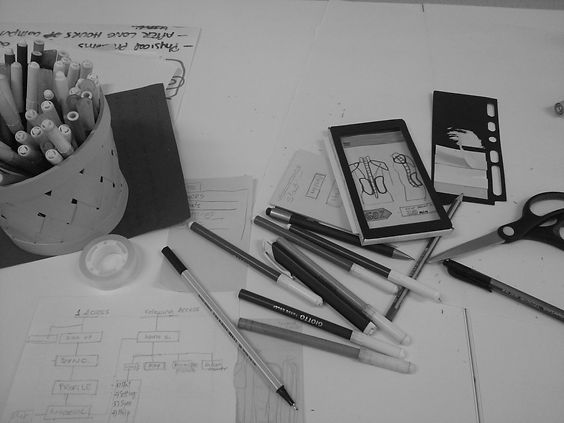


The ideas generated focused on body tracking and providing real-time feedback to users. The proposed solutions allowed users to monitor their posture through portable, sensor-enabled devices. This led to a range of wearable concepts, including a necklace, a watch connected to a sensor, and a waistband.
The concept selected for prototyping was a smart bra designed to detect changes in posture and provide haptic feedback, enabling users to become aware of and correct poor posture.
The prototype was tested with potential users. It consisted of an Arduino board connected to a tilt sensor and three vibration motors positioned on the left shoulder, right shoulder, and middle back. The motors were programmed to provide feedback based on the tilt detected along the XY axis. For example:
-
A vibration on the back indicated the user should lean forward.
-
A vibration on either shoulder signalled the need to lower that shoulder.
After a few iterations and adjustments to the code, the prototype responded accurately to postural changes, effectively prompting users to correct their posture through targeted vibrations.


UX TOOLS
▪︎ Co-design workshop
▪︎ Concept testing
▪︎ Interview
PAIN POINTS
▪︎ All participants reported experiencing back pain when using a computer for extended periods.
▪︎ Some users stated that they would continue working despite the pain.
▪︎ Others said they try to change positions, move around, or alternate between sitting and lying down.
▪︎ Users who rely on ergonomic furniture noted that such solutions are not portable.
INSIGHTS
▪︎ To improve posture over time, users must be aware of their posture.
▪︎ In order to enhance awareness while working or studying, users need to be reminded of it somehow from time to time.
▪︎ Users must be educated on how to adjust their posture while using the computer.
▪︎ The design solution should be portable.
DESIGN IDEAS
▪︎ Sensors for tracking.
▪︎ Haptics for feedback.
▪︎ A wearable solution or a mobile device (or both).

During concept testing, users were highly enthusiastic about the idea. They all expressed a genuine need for a solution like this and said they would like to see the product brought to market.
However, this remains an experimental project that would require further investment to be commercialised. The final product would need to be developed using smart fabric that is both breathable and washable.
ROLE
UX researcher & designer
LOCATION
Estonia
PARTICIPANTS
10+ users & designers
▪︎ College students
▪︎ Designers from Brazil, China and Russia.